




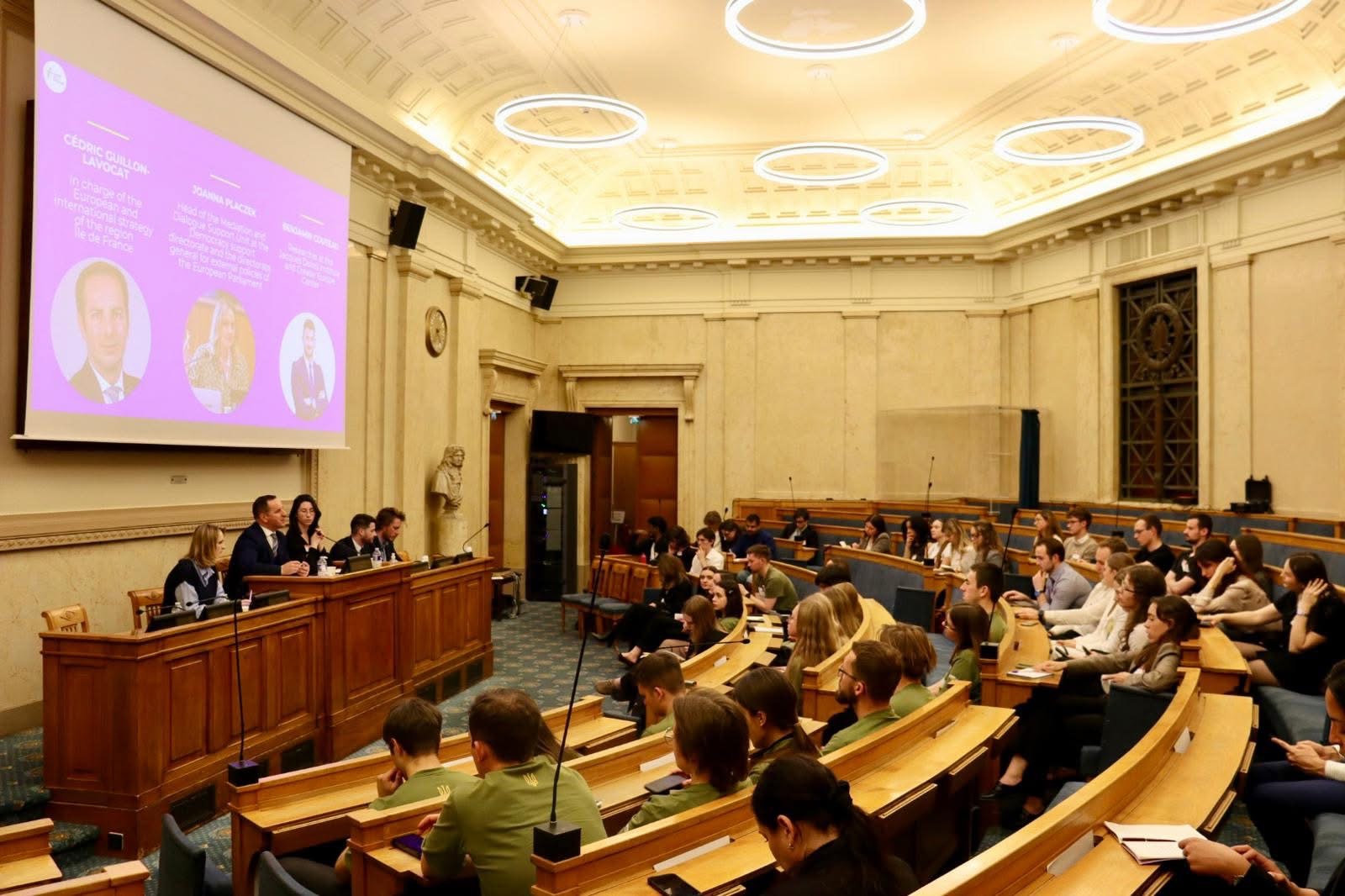
On 23 March, we organized a conference at the French National Assembly, in the Colbert Room, dedicated to Ukraine’s accession to the European Union and the democratic engagement of young people. Supported by the Île-de-France Region as part of its Europe programme, the event brought together students from the Ukrainian Leadership Academy and the Académie Notre Europe.
The meeting opened with remarks by Edward Mayor, President of Stand With Ukraine; Vadym Omelchenko, Ambassador of Ukraine to France; and Gabriel Attal, President of the France–Ukraine Friendship Group at the National Assembly.
At the heart of the conference was an interactive exchange between the students and three speakers: Cédric Guillon-Lavocat, in charge of European and international strategy for the Île-de-France Region; Joanna Placzek, Head of the Mediation and Dialogue Support Unit at the Directorate-General for External Policies of the European Parliament in France; and Benjamin Couteau, researcher at the Jacques Delors Institute and the Centre Grande Europe.
The discussions first highlighted one central point: the European Union needs Ukraine. Benjamin Couteau and Joanna Placzek stressed that this integration is based not only on shared values, but also on concrete strengths: an experienced army, a capacity for technological innovation, and a high-performing agricultural sector. In a context where Europe and Ukraine are facing a common enemy, accession appears to be a major strategic step.
They also addressed the challenges that still need to be overcome, particularly in the fight against corruption and the consolidation of the rule of law. On this point, Joanna Placzek recalled that similar concerns had existed during Poland’s integration, whether regarding cultural integration, social dumping, or access to European funds, before gradually being resolved.
For his part, Cédric Guillon-Lavocat highlighted the reality of the cooperation already under way between France and Ukraine, particularly at the level of the Île-de-France Region, through partnerships between municipalities, universities, and research stakeholders.
The students then questioned the speakers on broader issues, including the influence of current geopolitical balances, the respective expectations of Europeans and Ukrainians, and the concrete prospects for integration. The conference concluded with the testimony of a Ukrainian student, who powerfully recalled her country’s historic rootedness in Europe, the values they share, and the need for this belonging to be fully recognized.
Thank you to all the speakers and students for the quality and commitment of the discussions.


